
Ovarian stimulation process in Nepal- Fertility Centre Nepal
Category : blog
What is the ovarian stimulation process in Nepal?
Nepal is quickly becoming a top choice for patients who are seeking IVF treatment from all around the world. There are many reasons why Nepal is at the top of the list of medical tourism countries. One of them is that IVF treatment costs in Nepal are significantly lower than in any other Western country, even compared to India.
If we are talking about the standard IVF treatment cost in Nepal is typically from 2,50,000 to 4,50,000 Nepali rupees. However, this is significantly lower than in Western countries such as the United States, where treatment generally begins at $ 20,000. The IVF treatment cost in Nepal gives you a very high return on investment rate, also because Nepal has a very high fertility rate, with the advanced technology.
Not only does your package of whole IVF treatment actually have a very skilled specialist, but they also offer personal care. Before actually understanding what the ovarian stimulation process in Nepal entails, let’s understand what the IVF treatment costs in Nepal actually include in their packages.
The IVF process is very simple; it starts with ovarian stimulation, and it ends with embryo transfer. Usually, the whole IVF treatment has 5 basic stages. Ovarian stimulation process in Nepal, egg retrieval, and then there is fertilisation of the egg and the sperm. Then, the embryo culture and embryo transfer.
All these are included in your IVF treatment cost in the Nepal package. The whole IVF treatment cost in the Nepal package is almost 30% made up of the Ovarian stimulation process in Nepal. Let’s understand the IVF process in Nepal.
What is the process of IVF in Nepal?
IVF is known as in vitro fertilisation, meaning fertilisation that takes place outside the body. Fertilisation, which is the fusion of the egg and the sperm, is a result of intercourse. In this article, we are going to explain how the whole IVF treatment works and whether you even need it.
IVF is a simple treatment where doctors perform a minimum month-long regimen to let your body be ready to have the baby. Additionally, there are different types of phases in this treatment; however, the basic phases include these five.
- First consultation: Of course, every couple needs to have the first counseling session with an IVF expert. They will make sure to find out the exact reason for your infertility and the inability to have a child. This is done through several tests like AMH.
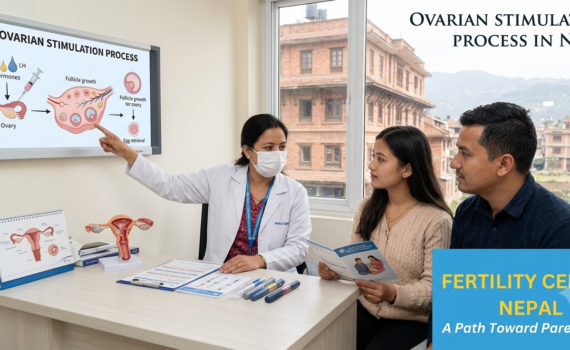
- Ovarian stimulation process in Nepal: This is the process in which the eggs of the female partner are stimulated through a series of injections so that her ovaries can produce multiple eggs at once. Usually, a female’s body only releases one egg per month, but because of these drugs, such as FSH, also known as follicle-stimulating hormone, and LH, luteinizing hormone, all of which are encouraged to produce and release more than one egg, preferably 8 or 10.
- Egg retrieval: In the egg retrieval process, doctors perform a small surgery known as transvaginal oocyte retrieval (TVOR). It is a very minor surgery, so you can go home on the same day. Doctors use the ultrasound device so that they can see the actual image inside your body.
At first, they insert a thin, hollow needle, which is attached to the ultrasound device. This needle is gently passed through your vaginal wall and enters directly into your ovaries. Then the doctors gently vacuum the follicle fluid containing the eggs. This process takes about 45 minutes.
Whereas if the men’s sperm is needed, they are extracted through masturbation. However, if there is a problem with male fertility, doctors could perform surgery to retrieve the sperm directly. The names of the surgeries are PESA, MESA, and many more.
- Fertilisation and Embryo Culture: The next process is actually fertilizing the collected egg and the collected sperm. There are two methods. The first is the conventional method, where thousands of sperm are placed in the same spot with or without only one egg. The second method is Intracytoplasmic Sperm Injection (ICSI). After fertilization has occurred, the embryo phone so the doctors will now transfer it into the incubator. An incubator is a device that behaves as an artificial woMB or uterus.
Till the embryo has reached a state where it is healthy and strong enough to be transferred to the actual uterus of the intended mother. Some people actually freeze their fertilized, healthy embryos for future use.
In some cases, when the timing is not right and when individuals want to focus on their careers or due to any medical conditions, they could actually use this frozen embryo for further embryo transfer when they want to have children in the near future.
- Embryo transfer: The last stage in this process is embryo transfer, in which the embryo is healthy enough. The doctors actually transferred this embryo to the uterus. There are two types of embryo transfer: the first is Fresh embryo transfer, and the second is frozen embryo transfer, which we have talked about earlier.
In the fresh embryo transfer process, first of all, doctors prepare the bladder so they can actually see the full display, so the doctors can actually see the uterus in full display through the ultrasound device. Then, a very thin, flexible plastic tube known as a transfer catheter is used. This catheter has embryo liquid.
This tube is inserted into the vaginal wall and passes directly through the cervix till they reach the uterine cavity. The uterine cavity is the place where the embryo attaches itself to the mother’s uterus. The uterine cavity actually provides nutrients and essential oxygen levels to the baby. Through the blood of the mother.
When doctors actually reach the uterine cavity, they gently release the embryo’s liquid inside the uterine cavity. This surgery is a very low-impact surgery. After the surgery is done, the patients typically rest for about 10 to 15 minutes before heading home.
What is the ovarian stimulation process in Nepal ?
In IVF, the ovarian stimulation process in Nepal is the phase where women’s eggs are being readied, so doctors can retrieve the eggs from their ovaries. So, how it is done is that experts, basically IVF doctors, give the hormonal injection or drugs to the woman so her ovaries can produce more than one egg simultaneously.
The Ovarian stimulation process in Nepal
In a natural monthly cycle, a woman’s body typically matures and releases only one egg. During the Ovarian stimulation process in Nepal, the goal is to use hormonal medications to “rescue” and mature multiple eggs simultaneously. Growing a higher number of eggs increases the chances of successful IVF, as it creates a larger pool of opportunities to achieve a viable embryo.
This phase typically lasts 8 to 12 days and requires close monitoring via regular blood tests (to track estrogen) and ultrasounds (to measure the growth of the fluid-filled sacs, called follicles, holding the eggs).
Medications Used in the Ovarian stimulation process in Nepal?
To Stimulate Egg Growth (Gonadotropins): Meds like Gonal-F, Follistim (FSH), and Menopur (FSH + LH) prompt the ovaries to grow multiple follicles.
To Prevent Premature Ovulation (GnRH Antagonists/Agonists): Meds like Cetrotide, Ganirelix, or Lupron keep the body from releasing the eggs naturally before they can be collected.
The Final Maturation (The Trigger Shot): Shots like Ovidrel, Novarel, or Pregnyl are timed precisely to mature the eggs right before the surgical egg retrieval procedure.
The Ovarian Stimulation Process in Nepal at a Glance
| Phase / Days | Ovarian stimulation process in Nepal |
| Days 1 to 3 | Transvaginal ultrasound and blood work to ensure no large cysts. Hormonal injections begin. |
| Days 4 to 7 | Follicles begin growing. A second injection (antagonist) is added to block premature ovulation. |
| Days 8 to 11 | Monitoring becomes daily or every other day to track final follicle sizes (aiming for 15to22 mm). |
| Day 12 (the Trigger) | Final maturation shot given at a precise, down-to-the-minute time before retrieval. |
How much does IVF cost in Nepal?
IVF Costs in Nepal in 2026 have changed because of inflation and many updated laboratory standards and advanced equipment. From 3 lakh and go up to 5 class Nepali rupees. All the streaming and diagnostic tests take around 30 thousand Nepali rupees, which covers the follicles stimulating hormonal test (FSH) and AMH testing to check ovarian reserve. It also covered basic transvaginal ultrasound, semen analysis, and any infectious disease screening.
Whereas the ovarian stimulation involves daily hormonal injections for up to 8 to 12 days to actually stimulate your ovarian follicles. On the way, you can expect 80,000 to 2,50,000 rupees.
Whereas the lab fertilisation will cost around 1,50,000, and for the embryo culture, the IVF treatment cost in Nepal, 2026, actually includes about 80,000 to 2,00,000, depending on how many embryos are developed
In IVF treatment cost in Nepal, 2026, embryo transfer is one of the most updated cost brackets, which has gone up to 1 lakh Nepali rupees.
How painful is ovarian stimulation?
Well, it depends on the injections. Many women who have been through ovarian stimulation in IVF share ot have felt the sharp stinging pain because of their injections. Injections are the top choice for receiving the shots and the needed doses for the ovarian stimulation process in Nepal.
IVF-C is a trigger shot that is given during the ovarian stimulation phase. Once your follicles have grown to their mature states, doctors give the shot of luteinizing hormone (LH) to release the mature eggs, so that they can just start the process already. About where the injection is given in your body, it entirely depends on the instructions given by your doctor.
However, injection is administered either into fatty tissues or deep into the muscles. The fat tissue method is most common, as the needle is very thin and short, and it will cause minimal discomfort. The most common places are the abdomen or the outer thigh.
Next is the deep muscle section. In this method, the upper outer buttocks or outer arm is the best alternative.
Is a husband’s sperm used in IVF?
Yes, a husband’s sperm can be used in IVF directly based on the health demographics of both partners. For example, in some cases, if there is a problem where the male fertility is the issue, such as low sperm count, low movement in his sperm, or there is a problem with the shape of his sperm, then in these cases, most of the doctors actually recommend a sperm donor.
But of course, there are a lot of ways we could actually work around it. For instance, when there is a low sperm count, doctors actually perform surgical operations to retrieve the sperm from the testicles or testes, and then choose the best and healthiest sperm. In these cases, the method of ICSI is used.
So, it is entirely based on each patient’s case.
How much does the ovarian stimulation process in Nepal cost?
| Cost Category | United States | India (INR) | Nepal (NPR) |
| Stimulation Medication | 3,000 to 7,000 | 40,000 to 1,20,000 | 50,000 to 1,50,000 |
| Clinic Monitoring | 1,500 to 3,500 | 10,000 to 25,000 | 15,000 to 30,000 |
| Estimated Phase Total | 4,500 to 10,500 | 50,000 to 1,45,000 | 65,000 to 1,80,000 |
How many days is the ovarian stimulation process in Nepal?
Exactly how many days of the ovarian stimulation process in Nepal depends on the patient’s case; it all depends on how many days your ovaries will take to release the follicles. However, typically, the Ovarian stimulation process in Nepal phase for most women lasts for about 8-12 days.
IVF experts will prescribe the dose based on your needs. For example, women who have PMOS are generally just given doses to control their hormones like LH (Luteinizing Hormone) and FSH (follicle-stimulating hormone). Additionally, there is also another phase of pre-treatment preparation so that the body is ready to receive the medication.
How much is 1 round of IVF?
| Procedure | Estimated Cost (NPR) | Estimated Cost (USD) |
| Consultation & Initial Tests | 10,000 to 20,000 | 75 to 150 |
| Ovarian stimulation process in Nepal: Medications | 80,000 to 1,20,000 | 600 to 900 |
| Egg Retrieval & Lab Charges | 70,000 to 1,00,000 | 525 to 750 |
| IVF/ICSI Procedure | 90,000 to 1,50,000 | 700 to 1,150 |
| Embryo Transfer | Included in the IVF package | Included |
| Pregnancy Test & Follow-up | 5,000 to 10,000 | 40 to 75 |
| (Optional) Embryo Freezing | 30,000 to 50,000 | 225 to 375 |
Special extra cost: Ovarian stimulation process in Nepal
| ICSI injects sperm right into the egg for male issues. |
| It adds 25,000 to 40,000 rupees. Not every case needs it, but it boosts chances. |
| PGT screens embryos for genes before transfer. |
| Think 50,000 to 80,000 rupees extra. It’s a key for age or family history worries |
| Assisted hatching thins the embryo shell for better implantation |
| 15,000 to 30,000 rupees |
Why are IVF babies usually boys?
Babies born from IVF tend to be male. This is because male embryos are more prone to develop slightly faster in the lab. However, if you’re more prone to getting equal odds of both genders at a fertilisation, when you choose ICSI as your fertilisation method. Additionally, it is illegal to identify the gender of the IVF. Under the Safe Motherhood Reproductive Health Rights Act (2018), sex determination of a fetus is not permitted and is a punishable criminal offense. The embryo selection is where the selection takes place. Male embryos carrying X and Y chromosomes develop earlier than female embryos carrying XX. As a result, these embryos are considered to be of higher quality for the transfer.
Frequently asked questions
- What is the best IVF clinic in Nepal?
Fertility Centre Nepal clinic is the top choice for any couple seeking IVF treatment. It is headquartered in Nepal. It has been in the Field of assisted reproductive technology for more than a decade. More than 8000 successful pregnancy cases.
The IVF charges in Nepal include one IVF cycle with the partner’s eggs and sperm. It provides pregnancy results if the couple’s gametes and reproductive health are average. They have fewer chances of poor health and fertility status. Their IVF treatment can face multiple failures that affect the IVF charges in Nepal. Your expert can suggest advanced IVF treatment or various approaches in the process for successful outcomes.
Many procedures are available to assist with different infertility conditions in IVF to help couples become parents. Our highly experienced and certified experts will suggest the best process according to your requirements and a budget-friendly approach.
At the most affordable prices
The IVF procedure cost in Nepal comes under the price bracket of NR 3,14,862.57 to NR 3,81,651.60. Your price may go up if the couple decides to undergo advanced fertility treatment due to their severe infertility issue. The fertility expert will harvest your eggs in the fresh cycle. They will monitor the period of ovulation-inducing medications. After that, they mix your eggs with fresh sperm.
The mentioned price range for IVF treatment in Nepal includes the Initial consultation with the fertility expert, complete IVF/ ICSI cycle procedure, Blood tests, ultrasound scans, male and female blood investigations, Egg pick-up and embryo transfer, and the fees of your fertility expert/embryologist.
- How can I increase my chances of success in IVF?
You can increase your chances of IVF chances of success. With Cost and by making small changes in your lifestyle, such as eating the Mediterranean diet, maintaining a healthy weight and height ratio, engaging in low-impact exercises, having good sleep, managing stress, and avoiding smoking and alcohol.
- What is the success rate of IVF in Nepal?
| Age Group | Success rate of IVF in Nepal |
| Under 35 | 50% to 60% |
| 35 to 37 | 45% to 50% |
| 38 to 40 | 25% to 35% |
| Over 40 | 10% to 15% |
The Success rate of IVF in Nepal is actually based on many factors, such as individual needs and how much treatment is needed. But in general terms, the overall Success rate of IVF in Nepal ranges from 50% to 65% per cycle.
Let’s go through these in two different categories: The success rate of IVF in Nepal could be measured by the age group, and it could also be measured by the kind of treatment you are receiving.
If you’re under 35, your chances of having a successful outcome are 50 to 60%. After the age of 35, it starts to deteriorate by 50% to 45%. By the time you reach 38 and 40 years of age, your chances of success have already dropped by 25 to 35%. The rates for the decline over the age of 40 are 10% to 15% when using your own eggs.
| Treatment Type | Success rate of IVF in Nepal |
| IVF with Donor Eggs | 70% to 85% |
| IVF with ICSI | 55% to 65% |
| Frozen Embryo Transfer (FET) | 50% |
Now, let’s go to the treatment types. There are very different types of treatment in IVF. If you are doing IVF with donor eggs, the success rate of IVF in Nepal is 70% to 85% because the donor eggs are usually donated or retrieved from a very young candidate.
So the success rate of IVF in Nepal, if you actually have a child, increases by that.
The second type is IVF with the ICSI method. IVF is done through this method when just one healthy sperm is injected into a healthy egg. The chances of IVF success in Nepal have increased from 55% to 65%, and this is also more successful than regular IVF.
The Frozen embryo transfer, also known as FET, has a 50 to 55% success rate.
Know the Factors that affect the Success rate of IVF in Nepal
- There are factors that we have to consider before actually thinking about the successful treatment. Even though the success rates we have discussed with you are mentioned, there are many factors at play. One of them is what causes infertility. There are thousands or millions of things that can go wrong in your body. And they could challenge your goal to have a child.
- So doctors, when they actually do the initial consultation, they make sure to know what kind of fertility issue you’re having. If you have a blocked fallopian tube, it would depend on what kind of treatment you get and what kind of chances you will have.
- For example, let’s say that you have PMOS. In PMOS, the cost of the treatment increases, and the chances are low because the body of the woman during PMOS is already in a high alert mode. And during the ovarian stimulation phase, doctors might not want to actually stimulate your ovaries for longer.
- In pregnancy history, there are studies that have shown that women who have had a successful previous pregnancy are more likely to have a successful IVF treatment.
- There is a clear difference between the pregnancy and live birth rates. The success rates that we have discussed now are the successful fertilisation and transfer of the embryo, which was created in the lab. It does not mean that you would have a successful pregnancy; these are two different terms. A thousand things could go wrong after the successful embryo transfer. Maybe after 2 or 3 weeks, your body can kill the implanted embryo. So ask for live birth rates, not just success rates.
Does the IVF process have any negative side effects?
IVF uses the best techniques and tools available. In cases where a couple is unable to conceive, it aids in a healthy pregnancy outcome. For better outcomes, the tactic can also be utilised in conjunction with other techniques. Certain intrusive steps are also part of the therapeutic process. For some people, it might be an issue. A gadget is used to implant gametes and harvest eggs. Other organs’ health can be affected. The couple might encounter miscarriage, labour problems, an early delivery, an ectopic pregnancy, and signs of multiple births. You can still manage these conditions if you have access to contemporary assistance and the right course of therapy.
- Do I need IVF treatment?
If you have any difficulties in conceiving naturally due to infertility, you can book an IVF consultation in Nepal. All infertile couples are aware that IVF treatment is one of the best fertility treatments that can give infertile couples the chance to have their own baby. The fertility treatment is designed for couples who are not able to conceive naturally due to the following factors:
- Blocked fallopian tubes
- Ovarian failure
- Unexplained infertility
- High consumption of alcohol
- Low or poor sperm count
- Abnormal shape of sperm, which results in poor mobility
- Sperms are not present in semen
- Age over 35 years in the case of women and 38 years in the case of men
- Repeated history of miscarriages