
Egg Retrieval Process In Nepal – Fertility Centre Nepal
Category : blog
What is the IVF Process in Nepal?
Ovary stimulation: This is the process in which the eggs of the female partner are stimulated through a series of injections so that her ovaries can grow multiple eggs at once. Usually, a female’s body only releases one egg per month, but because of these drugs, such as FSH, also known as follicle-stimulating hormone, and LH, luteinizing hormone, all of which are encouraged to produce and release more than one egg, preferably 8 or 10.
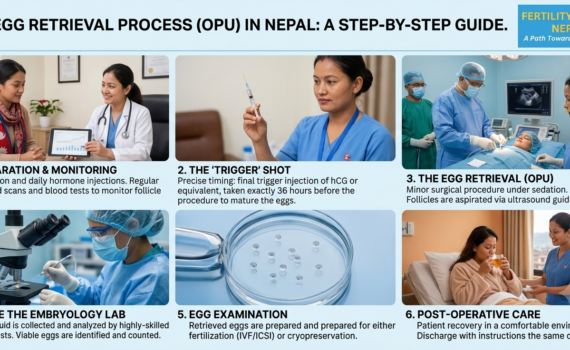
In the egg retrieval process in Nepal, doctors perform a small surgery known as transvaginal oocyte retrieval (TVOR). The egg retrieval process in Nepal is a very minor surgery, so that you can go home on the same day. Doctors use the ultrasound device so that they can see the actual image inside your body.
At first, they insert a thin hollow needle, which is attached to the ultrasound device. This needle is gently passed through your vaginal wall and enters directly into Your Ovaries. Then the doctors gently vacuum the follicle fluid containing the eggs. This process takes about 45 minutes.
Whereas if the men’s sperm are needed, they are extracted through masturbation. However, if there is a problem with male fertility, doctors could perform surgery to retrieve the sperm directly. Names of the surgeries are PESA, MESA, and many more.
The next process is fertilizing the collected egg and sperm. There are two methods. The first is the conventional method, where thousands of sperm are placed in the same spot with or with only one egg. The second method is Intracytoplasmic Sperm Injection (ICSI).
Embryo culture and development: The fourth stage in the process of in vitro fertilization, IVF, is embryo culture and development. After fertilization has occurred, the embryo is now formed, so the doctors will now transfer it into the incubator. An incubator is a device that behaves as an artificial womb or uterus.
Till the embryo has reached a state where it is healthy and strong enough to be transferred to the actual uterus of the intended mother. Some people actually freeze their fertilized healthy embryos for future use.
In some cases, when the timing is not right and when individuals want to focus on their careers or due to any medical conditions, they could actually use this frozen embryo for further embryo transfer when they want to have children in the near future.
If the embryo is healthy enough. The doctor will transfer this embryo to the real uterus. There are two types of embryo transfer: the first is Fresh embryo transfer (FET), and the second is frozen embryo transfer, which we have talked about earlier.
In the fresh embryo transfer process, first of all, doctors prepare the bladder so they can actually see the full display through the ultrasound device. Then, a very thin, flexible plastic tube known as a transfer catheter is used. This catheter has embryo liquid.
This tube is inserted into the vaginal wall and passes directly through the cervix till they reach the uterine cavity. The uterine cavity is the place where the embryo attaches itself to the mother’s uterus. This uterine cavity actually provides nutrients and essential oxygen levels to the baby. Through the blood of the mother.
When doctors actually reach the uterine cavity, they gently release the embryo’s liquid inside the uterine cavity. This surgery is a very low-impact surgery. After the surgery is done, the patients typically rest for about 10 to 15 minutes before heading home.
Egg Retrieval Process in Nepal
Estimated Cost Breakdown
| Component | Approximate Cost (NPR) | What It Covers |
| Initial Procedures and Retrieval | 100,000 to 300,000 | Ovarian stimulation monitoring, hormonal injections, egg retrieval surgery, and initial flash-freezing (vitrification). |
| Annual Storage Fee | 10,000 to 25,000 per year | Secure cryopreservation maintenance in liquid nitrogen tanks to keep the eggs viable. |
| Preto Procedure Testing | 15,000 to 30,000 | Initial fertility assessments, blood panels (AMH, FSH, LH), and transvaginal ultrasounds. |
Success rate of IVF in Nepal
| Patient Category | Success Rate of IVF in Nepal |
| Women under 35 years | 60% to 70% |
| Women aged 35 to 37 | 50% to 60% |
| Women aged 38 to 40 | 40% to 50% |
| Women over 40 years | 25% to 35% |
| IVF with Donor Eggs | 65% to 75% |
| IVF with ICSI (Intracytoplasmic Sperm Injection) | 55% to 65% |
| Frozen Embryo Transfer (FET) | 50% to 60% |
| IVF with PGT (Genetic Testing) | 60% to 70% |
How to Measure IVF Success Rate?
To check the success rate of IVF in Nepal, start by researching accredited fertility clinics with transparent reporting. Reputable clinics often publish their IVF success rates based on age, procedure type, and patient condition. Look for third-party verifications, patient testimonials, and clinic certifications. It’s essential to compare live birth rates, not just pregnancy rates, for accuracy. Also, consult with the clinic directly to understand how their statistics apply to your case, including factors like age, egg quality, and underlying fertility issues.
- Research accredited fertility clinics in Nepal with good reputations.
- Visit official clinic websites to find published IVF success rates.
- Ensure the data is recent and categorised by age group and procedure type.
- Look for success rates based on live births, not just pregnancies.
- Check for third-party audits or regulatory body certifications.
- Read verified patient reviews and success stories for insights.
- Consult directly with the clinic’s fertility specialist for personalised success probability.
- Ask about the number of cycles done annually and their cumulative success rate.
- Verify use of advanced techniques like ICSI, PGT, or blastocyst culture.
- Understand factors affecting success, like egg/sperm quality, uterine health, and lifestyle.
Egg freezing process
The egg freezing process start by doctor prescribing you a couple of tests. The tests are done to make sure how much egg reserve you have in your ovaries. The egg freezing process in Nepal is very advanced and at a very affordable cost.
First, initial testing and preparation. Doctors will start by taking your blood test, and a pelvic ultrasound will be done. Doctors do this because they want to check your ovarian reserve. Ovarian reserve is a measure, and it is a ratio of how many eggs you have actually left in your ovaries, and according to them, they tell your medication doses. In the next step, you will learn why you need medication.
The next step is ovarian stimulation. In this step of the whole process, the ovarian stimulation is usually for 10 to 12 days. Normally, your body matures only one egg per month, as we have said, but you are going to freeze eggs, so doctors want as many as possible so that they can actually freeze the healthiest ones. To stimulate your body to produce more than one, they give you hormonal injections daily for nearly 2 weeks. The tests in the first place are done for this phase. The drugs that are used for ovarian stimulation are known as follicletostimulating hormone (FSH) or luteinizing hormone (LH).
The next step is the retrieval of these eggs. A doctor performs a very minor surgery known as follicular aspiration, which is a very minimally invasive outpatient procedure. It is done in 20 to 45 minutes without any complications. The process of this surgery involves putting you under anesthesia, so you will feel no pain after that. With the guidance of the ultrasound, a small needle that is attached to the ultrasound probe device will be inserted into your vagina.
It will pass through the cervix opening and into the ovaries. A small, gentle suction pressure will be used to gently suck out the fluid that contains the egg. After 15 to 30 minutes, you can go home.
The next step in the process is vitrification. Human female eggs are the largest single cells of the body, and they are filled with water. So if you naturally try to freeze the water, small, sharp crystals will form. They could damage the eggs. So in the vitrification process, the goal is to drop the temperature so quickly that water does not have time to form those crystals; instead, they just freeze in that state.
Even though people think that it is a very small procedure, there are so many factors that are at play, such as what is the number of eggs. Even though doctors try to retrieve as many eggs as they can, not every egg actually matures, not every egg survives the freezing process, and not every egg will be used in the near future pregnancy treatment.
The quality of the egg is also based on the age of the female. Typically, the biological clock term is right because after 35, the egg quality starts to drastically drop.
Another factor that is at play is, what is the lifestyle of a woman. Even though she could be more than 35 years old, it does not mean that she cannot freeze her eggs; it just means that if her lifestyle is good, then there is a higher chance of her having healthy eggs.
The process is not 100% guaranteed. You can freeze eggs at the right age, you can decide to have children at the right age, but sometimes it is not 100% guaranteed that the freezing process will work for the future. It increases the chances of having children, but it does not give you 100% full pregnancy.
Egg freezing meaning
Many people have doubts about how egg freezing is practised in Nepal. Also, what is egg freezing in Nepal actually? Egg freezing is also known as gamete freezing. It is the process by which women prefer to freeze their eggs for future use. Let’s understand egg freezing in Nepal in simpler terms.
Egg freezing meaning in Nepali
Egg freezing in Nepal or any other part of the world is the same. It is performed in the same way, with the same precision. Women usually involuntarily produce eggs every month. If that egg is fertilised by the sperm, then a baby is conceived. If not, then menstruation happens. These eggs are important for pregnancy.
However, due to any foreseeable reasons, such as chemotherapy or any surgery, it will make it harder to conceive a child in the present. So, egg freezing in Nepal comes in handy. Egg freezing in Nepal is also known as mature oocyte cryopreservation. Doctors would actually freeze the egg in the formation when it’s mature, so that when the individual is ready, they can just unfreeze the egg and use it.
Egg freezing in Nepal is not as costly as in Western countries. The frozen egg can be used even if you do not use it for years on end. Now, let’s go through the egg freezing process in Nepal.
Egg freezing cost in India
Egg freezing in India involves a multi-step medical process. The average cost for a single complete cycle typically ranges from INR 1,20,000 to INR 2,50,000, depending on the clinic, your city, and the dosage of medication required.
| Stage | What It Covers | Approximate Cost (INR) |
| 1. Initial Assessment and Diagnostics | Specialist consultations, blood tests (such as Antimullerian Hormone/AMH), and pelvic ultrasound scans to check ovarian reserve. | 5,000 to 15,000 |
| 2. Ovarian Stimulation | Daily hormonal injections taken for 10 to 12 days to stimulate the ovaries to grow multiple eggs, along with monitoring scans. | 50,000 to 1,50,000 |
| 3. Egg Retrieval (Ovum Picktoup) | A minor outpatient surgical procedure performed under sedation or light anaesthesia to retrieve the mature eggs. | 30,000 to 1,00,000 |
| 4. Lab Freezing (Vitrification) | The advanced laboratory technique used to rapidly freeze the retrieved eggs using liquid nitrogen. | 30,000 to 60,000 |
| 5. Annual Storage | Recurring annual fee to safely preserve and maintain the frozen eggs in the cryogenic storage facility. | 10,000 to 30,000 per year |
Important factors to keep in mind:
- First year storage: Many top fertility clinics include the first year of storage within their initial cycle package, but it is always best to confirm this upfront.
- Number of cycles: Younger individuals often produce a high number of quality eggs in a single cycle. However, if the ovarian reserve is lower, a doctor might recommend a second or third cycle to retrieve an optimal number of eggs (typically 10 to 15), which multiplies the cost.
- Future costs: When you decide to use the eggs later, there will be separate charges for thawing, fertilisation via In Vitro Fertilisation (IVF) or Intracytoplasmic Sperm Injection (ICSI), and embryo transfer. This future phase usually costs between INR 70,000 and INR 1,50,000.
- Most health insurance plans in India treat elective fertility preservation as a non-essential or elective procedure, meaning it is rarely covered out of pocket, though many clinics offer monthly instalment (EMI) options to help manage the upfront expense.